Bank of Israel Buys $801 Million in Rare Market Intervention to Halt the Shekel’s Surge
Key Takeaways
- The Bank of Israel bought $801M in May to curb the shekel’s market rise, eyeing export stability.
- As Wall Street gains boost the shekel, Israel’s tech sector will next lay off more local workers in 2026.
- With tech at 57% of exports, Israel’s strong currency hurts margins, next driving firms to hire abroad.
Israel’s Shekel Hits New Highs Even As Bank Of Israel Intervenes in FX Markets
Israel’s economy is facing a dilemma, as its currency has maintained its strength even as the central bank actively seeks to decrease its value to maintain a healthy exchange rate.
While other currencies have lost value against the U.S. dollar since the current U.S.-Israel-Iran conflict emerged in February, the Israeli shekel has been gaining value, to the point that the Bank of Israel was forced to intervene in currency markets to curb its rise.
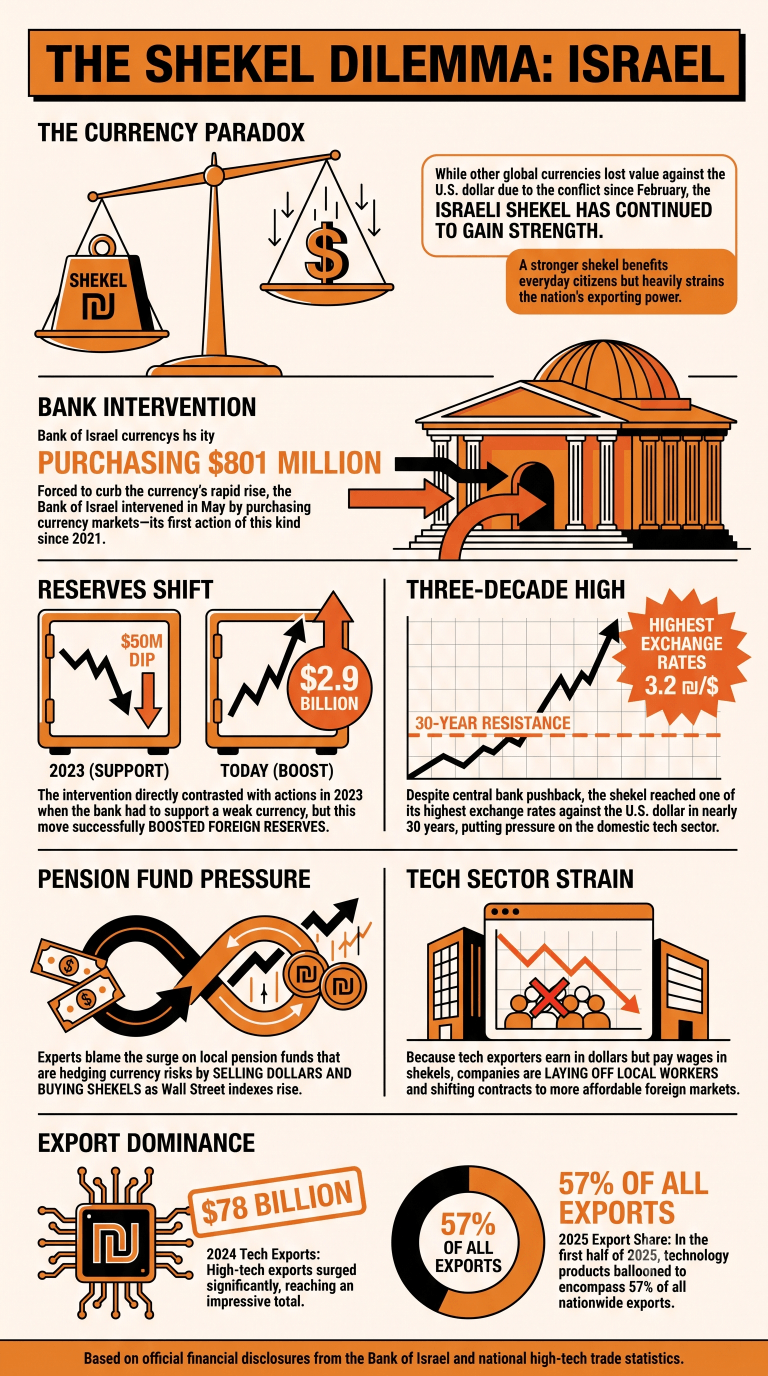
In a report released on Sunday, the Bank of Israel acknowledged that it intervened in currency markets by purchasing $801 million through several transactions during May. The interventions follow the need to maintain the “orderly functioning of the markets” and have helped increase foreign reserves by $2.9 billion.
This is the first movement of its kind to aid the Israeli shekel since 2021. The situation is opposed to what the shekel faced in 2023, when the bank had to intervene to support it.
Nonetheless, even with this push, the Shekel kept rising and reached one of its highest exchange rates against the U.S. dollar in almost three decades, an issue that is affecting the nation’s booming technology economy.
Some blame this rise in the pressure Israeli pension funds exert on the exchange market as they hedge currency risks by selling dollars and buying shekels as Wall Street indexes keep rising.
While in theory, a stronger shekel should be a good thing for everyday Israelis, it hampers the exporters’ ability to price their products competitively in foreign markets dominated by the U.S. dollar, but paying services and wages in shekels.
As a result, tech companies have been laying off local workers and resorting to contracting workers in foreign markets. High-tech exports rose to $78 billion in 2024 and reached 57% of all exports in the first half of 2025, magnifying the impact of this issue.