Fed Chair Warns Crypto Is on Its Own
Key Takeaways
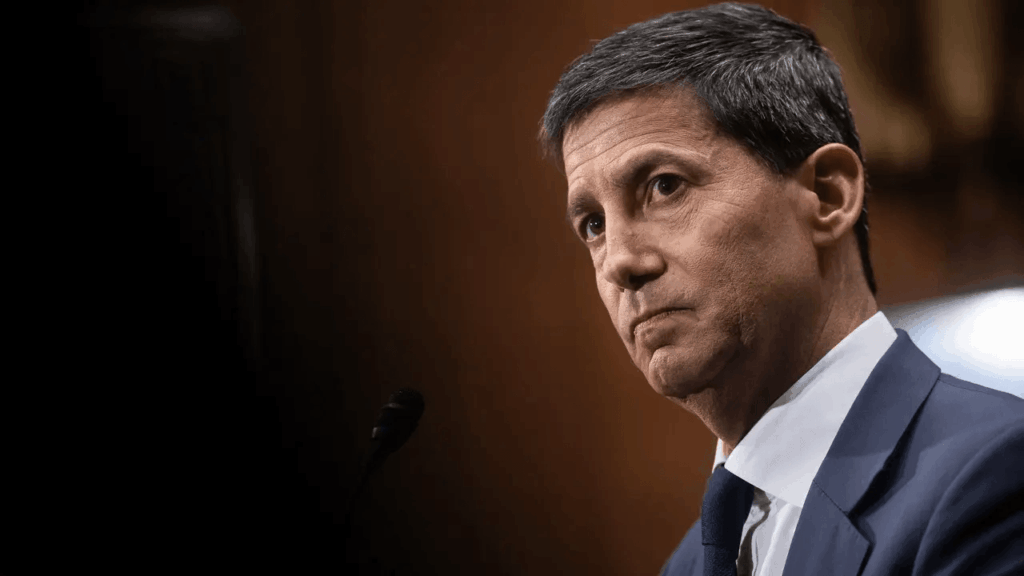
- Fed Chair Kevin Warsh told Congress on July 14, 2026 the Fed won’t bail out crypto or stablecoins.
- Rep. Brad Sherman pressed Warsh on a potential run in crypto markets during the House hearing.
- Warsh holds the Fed rate at 3.5% to 3.75% and will also appear before the Senate on Wednesday.
Warsh appeared before the committee for the Fed’s Semi-Annual Monetary Policy Report, a hearing known as the Humphrey-Hawkins testimony. He is also scheduled to appear before the Senate Banking Committee on Wednesday.
‘We Do Not Want to Be in the Bailout Business’
The exchange on crypto came during questioning from Rep. Brad Sherman, D-Calif., a longtime skeptic of digital assets who sits on the committee. Sherman asked Warsh directly whether the Fed would extend support to cryptocurrency or stablecoin markets the way it backstopped money market funds during the 2008 financial crisis.
Warsh opened his answer by pointing to his own history with that crisis. “I still have the scars from the 2008 financial crisis,” Warsh said. “We all carry the scars from the extraordinary efforts that my colleagues and I undertook under Chairman Bernanke’s leadership. That is not something we want to repeat.”
Sherman pressed further, asking Warsh to rule out a rescue of stablecoins and cryptocurrency specifically. Warsh answered in broader terms instead of naming the sector directly. Warsh told the panel:
“We do not want to be in the bailout business, full stop.”
Sherman noted that the Fed did step in for money market funds during the 2008 crisis and asked whether a similar shock in crypto markets would prompt the same response. Warsh held his position while leaving room for the Fed to act on the margins.
“We’re going to do everything we can to mitigate those sorts of extraordinary risks, if and when they arise over the next four years,” Warsh told Sherman. “We want to be in a position where we’re not bailing out anybody, including crypto.”
Sherman told Warsh he had not fully answered the question, then moved on to bank capital rules. He also flagged Kraken’s application with the Federal Reserve Bank of Kansas City as a concern tied to nonbank access to the payment system, a sign that lawmakers are watching how crypto firms plug into traditional banking infrastructure.
Warsh Calls Inflation ‘a Choice’
Inflation dominated much of the hearing. Warsh described inflation as a choice rather than an unavoidable outcome and noted the Fed’s rate-setting committee has no tolerance for price gains staying elevated. “The members of our committee have no tolerance for persistently elevated inflation,” Warsh stated. “And we share a resolute commitment to restoring price stability.”
The Fed held its benchmark rate at a range of 3.5% to 3.75% at its June meeting, Warsh’s first as chair. He told lawmakers the labor market looks balanced, with low unemployment, few layoffs and steady wage growth, meaning the Fed’s inflation and employment goals are not currently working against each other. Warsh added that sustained progress on inflation would eventually support lower long-term yields.
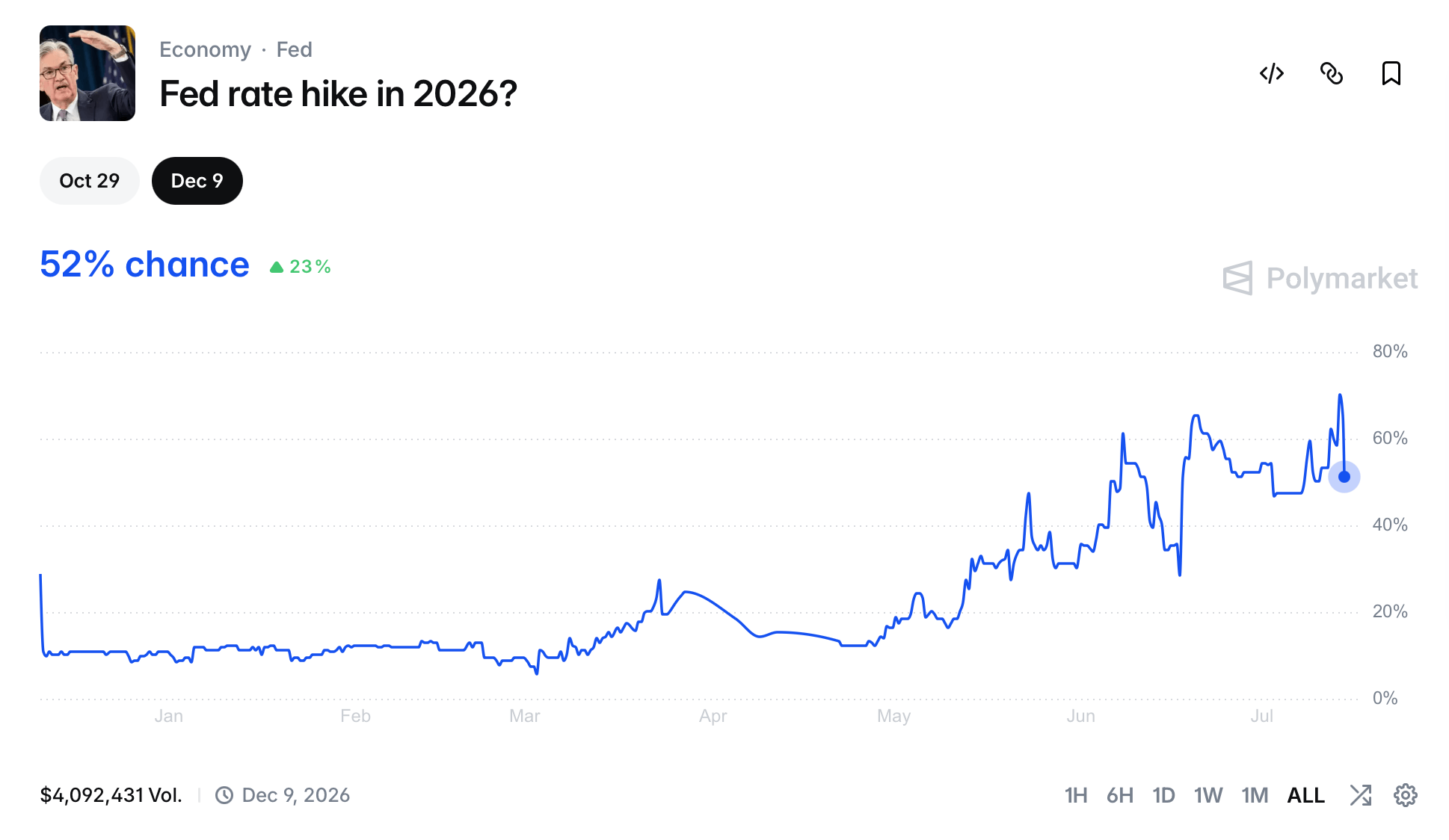
On Tuesday afternoon, July 14, prediction market bettors were pricing in the possibility that a rate hike could still materialize this year. Polymarket‘s event on the subject assigns a 52% probability that the Fed will raise the benchmark rate in 2026. Kalshi‘s market tracking the same question puts the odds at 48%. Polymarket’s probability declined from 66% yesterday to the current 52%, while Kalshi’s odds were above 60% on July 13.
AI Buildout Fuels Business Investment
Warsh pointed to business investment as the standout feature of the current economy. Overall equipment investment rose about 8% over the year ending in the first quarter, driven largely by data center construction tied to artificial intelligence. High-tech spending within that category grew nearly 25% on a four-quarter basis. “It seems inevitable that what is now called ‘AI investment’ will soon be called just ‘investment,’” Warsh said, adding that the Fed is watching what the buildout means for inflation and the labor market.
Five Task Forces Take a Fresh Look at Fed Practices
Warsh also outlined five task forces he created to examine the Fed’s practices from the ground up. The groups cover Fed communications, balance sheet policy, economic data sources, the impact of new technology on productivity and jobs, and the frameworks used to think about inflation. He said the teams are starting from “a blank sheet of paper” and will report internally to all 19 Fed policymakers before any public findings are shared.
Fed independence was another theme of the hearing. Warsh emphasized the central bank’s separation from political pressure, a point Sherman echoed in his opening remarks when he credited the Fed’s independence with helping prevent deeper inflation damage in recent years. The testimony landed on the same day as a fresh consumer price index reading and a batch of second-quarter bank earnings, giving investors and lawmakers several data points to weigh at once. Warsh avoided offering explicit guidance on the Fed’s next rate move, consistent with his approach since taking over as chair.
What This Means for Crypto Markets
For crypto markets, the message from Warsh was one of clear boundaries rather than open hostility. He did not signal opposition to digital assets broadly, and reporting has noted his relatively crypto-fluent background compared with past Fed chairs, along with disclosed crypto-related investments. But he made plain that market stress in the sector will not be met with the kind of liquidity facilities the Fed extended to money market funds in 2008.
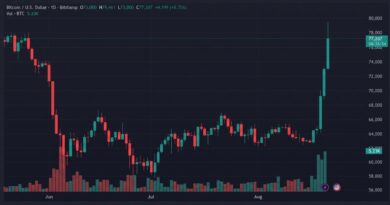
Bitcoin continued its advance on Tuesday, reaching an intraday high of $64,913 by 11:30 a.m. EDT. U.S. equities also extended their recovery, adding to the broader rebound across risk assets. Sherman also used part of his time to press Warsh on bank capital requirements, asking whether 2019-era standards were adequate or should be raised under the current reproposal.
Warsh stressed that a capital rule is out for public comment and he intends to review the responses before forming a judgment, pointing to strong capital ratios, liquidity, supervision, and market discipline as the pillars of a sound financial system.
Warsh’s testimony sets the tone heading into his Senate Banking Committee appearance on Wednesday, where lawmakers are likely to press him further on both inflation and the Fed’s posture toward digital assets.