
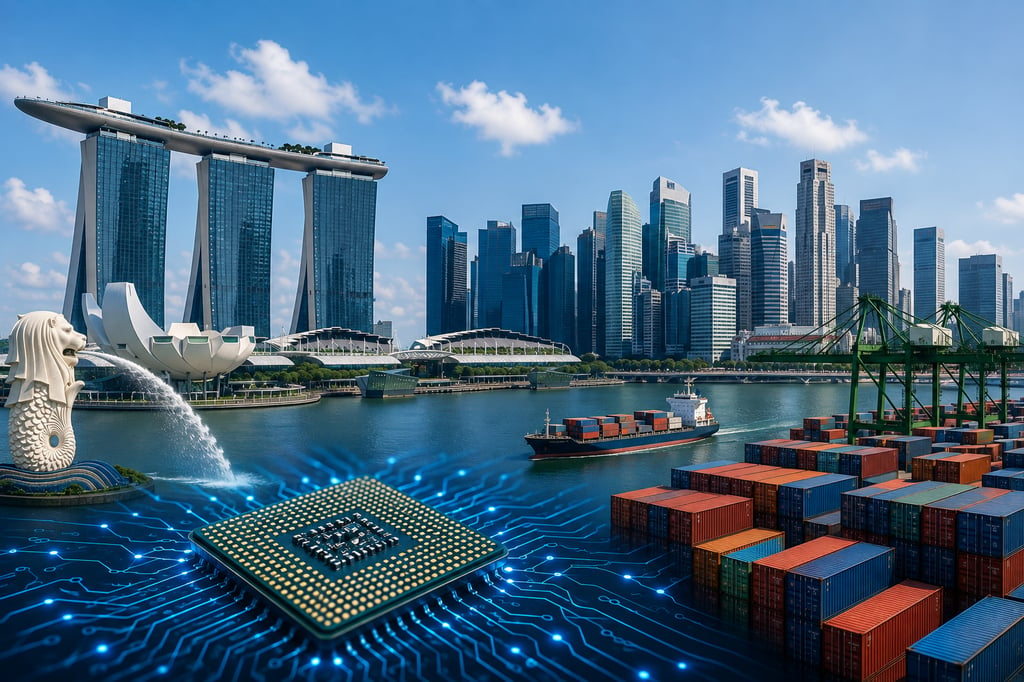
Singapore Raises 2026 Growth Forecast as AI Exports Surge
Singapore has raised its 2026 economic growth forecast to 4.5%–5.5% after stronger-than-expected global AI investment helped lift semiconductor demand, exports, and manufacturing output.
The upgrade turns the AI spending boom into something more concrete than rising tech valuations. For hardware manufacturers and suppliers across APAC, Singapore is showing how global AI capital spending can feed through into national growth. It also leaves those businesses more exposed if that spending cools.
AI demand is lifting Singapore’s exports and manufacturing
The new forecast is Singapore’s second upgrade this year. The Ministry of Trade and Industry raised its outlook from 1%–3% to 2%–4% in February before moving it to 4.5%–5.5% in August.
Singapore’s economy grew 5.9% year over year in the second quarter, pushing first-half growth to 6.1%. MTI said global AI investment had been stronger than expected, supporting producers and exporters of AI-related products such as semiconductors.
That connection is already visible in trade data. Singapore’s non-oil domestic exports grew 27.4% year over year in the second quarter, after rising 9.6% in the first.
Electronics exports grew particularly quickly as demand increased for integrated circuits, storage products, and other hardware used in AI systems. The same demand pressure is driving investment elsewhere in the supply chain, including SK hynix’s $38 billion memory expansion.
Singapore also sits close to the infrastructure side of the spending cycle. APAC operators are already dealing with larger AI data center fleets and tighter power constraints, while Singapore-based DayOne raised $2 billion earlier this year for its AI infrastructure expansion.
For technology suppliers, continued AI investment supports demand for chips, storage, semiconductor equipment, and the trade services surrounding them. Singapore’s revised forecast provides a measurable indication of how far that spending is reaching beyond the companies building AI models and data centers.
Singapore’s gains also reveal an AI concentration risk
The stronger AI contribution also increases the downside if investment slows.
The ASEAN+3 Macroeconomic Research Office estimates that roughly half of global AI-related trade passes through ASEAN+3 and that AI-linked exports generated around two-thirds of the region’s export growth in the first quarter.
AMRO raised its 2026 regional growth forecast to 4.1%, citing stronger AI-related demand. But it also modeled what happens if the cycle weakens: if global AI investment growth falls back to its 2024 pace, ASEAN+3 growth could slow to 2.5% in 2027, its weakest rate outside the pandemic years since the Asian Financial Crisis.
For manufacturers, semiconductor suppliers, and enterprise procurement teams, that makes global AI capital expenditure a useful signal alongside Singapore’s headline GDP numbers. Capacity plans built around today’s electronics growth still depend heavily on continued investment in the infrastructure and hardware supporting AI workloads.
Singapore’s upgraded forecast captures both sides of the cycle: AI investment is already strong enough to lift exports, manufacturing, and national growth, while greater dependence on that demand increases the exposure if spending changes direction.
Also read: Japan’s planned Akita AI data center is now estimated at $12.6 billion, with Mubadala considering an investment in the renewable-powered project.