
Binance Hack Fallout Keeps Bitcoin Price Under Pressure Below $77K
Key Takeaways
- Bitcoin fell below $77,000 on Monday as the Binance hack continued to weigh on investor confidence.
- Crypto liquidations reached $256 million, while Binance reported 100% backing for major assets.
- Bitget Wallet’s Alvin Kan warned that the $6.3 billion Binance breach could prompt a rethink of custody risks.
Bitcoin Drops Below $77K
Bitcoin slipped below $77,000 on Monday as the cryptocurrency continued to grapple with a crisis of confidence triggered by the massive Binance hack. Even Strategy’s latest bitcoin purchase failed to lift investor sentiment, while the fallout from the breach has driven billions of dollars in outflows from Binance ahead of the exchange’s highly anticipated proof-of-reserves report.
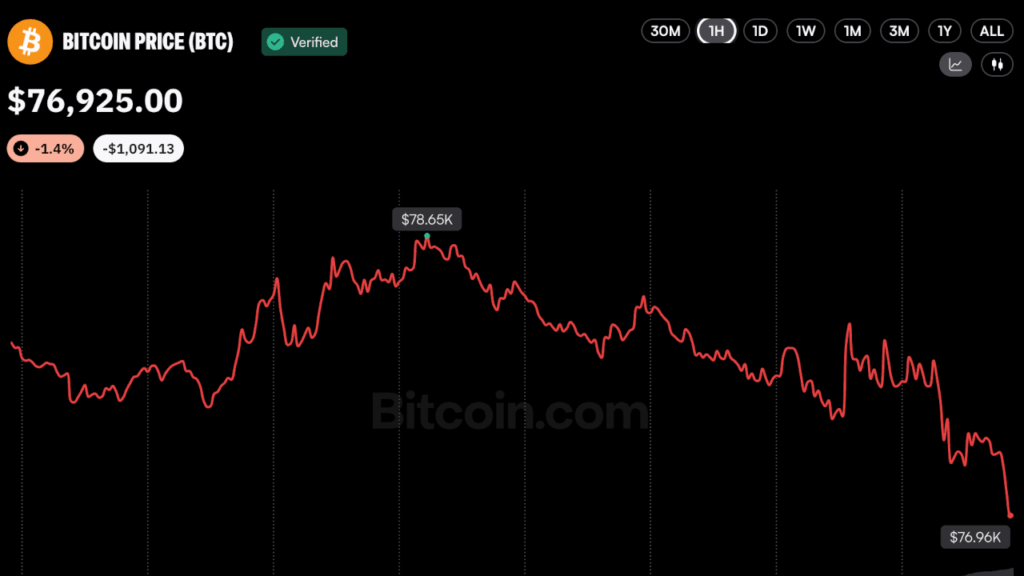
Market data, however, shows that the cryptocurrency experienced another volatile day as it swung heavily on either side of $78,000. Initially, the price was climbing, rising from under $77,600 to peak at $78,750 just before midnight on Sunday as bulls seemingly took charge. However, the upward momentum cooled immediately afterward, and by 9:30 a.m. EST, the price was back below $77,600.
For the next two hours, the price oscillated between $77,600 and $78,000 before a sell-off sent it tumbling to an intraday low of $77,143. At 12:45 p.m., the price hovered just below $77,000, leaving the cryptocurrency with a daily loss of 1.4% and its market capitalization stuck under $1.55 trillion.
Bitcoin’s apparent consolidation around $78,000 helped trim leveraged positions, which fell to $69 million, a dramatic decline from the more than $500 million recorded Oct. 30. As shown by Coinglass data, liquidated short bets reached nearly $30 million, with liquidated long bets accounting for the remainder.
Across the entire crypto market, liquidations reached $256 million, with wiped-out long bets accounting for more than $176 million of that total.
In its latest update, Binance said affected assets were replenished using its own funds and that several cryptocurrencies and digital assets—including BTC, ETH, USDT, BNB, SOL, USDC, XRP, RLUSD, and ZEC—were fully backed at 100%. In a statement, the exchange also said a full zero-knowledge proof for this latest proof-of-reserve snapshot has been completed.
“Binance users holding any of these 10 tokens can independently verify that their balances on Binance are backed at a minimum of 1:1,” the exchange added.
Another crypto exchange hack took place early Monday, potentially fueling even more fear and distrust across the industry. Mercado Bitcoin, the top exchange in Brazil, reported a breach that an Arkham Intelligence analyst said resulted in at least $46 million worth of stolen funds. The exchange said customer funds were not impacted, but it has yet to put an official number on the damages.
Custody Risks and Market Infrastructure Concerns
While Binance’s quick move to prove complete customer backing has been hailed, some critics argue that the real losers in the hacking fiasco were the more than 250,000 traders who were using too much leverage when news of the hack broke. According to Tobias Robinson, CEO of Daytrading.com, the more than $1.2 billion in liquidated long bets was largely a result of the 5% drop in bitcoin’s price.
“Bitcoin fell close to 5% after the news broke, and anyone who had borrowed to multiply their position twentyfold lost roughly their whole stake on that move,” Robinson said, adding that traders should run the numbers before the next shock rather than after it.
Meanwhile, Alvin Kan, COO of Bitget Wallet, said the Binance breach is a reminder that custody risk extends beyond private keys to operational access and transaction authorization.
“The incident may prompt more investors to reconsider exchange exposure, but a temporary withdrawal spike doesn’t necessarily mean a lasting shift toward self-custody,” Kan said. “Self-custody reduces reliance on centralized intermediaries, but it also requires stronger key management, real-time threat detection, and transaction safeguards. Giving users control is only meaningful when that control is secure.”
The broader question is whether market infrastructure can keep pace with expanding financial access. According to Kan, ICE’s agreement to develop regulated Hyperliquid-based perpetual markets reflects growing institutional interest in around-the-clock trading of traditional assets. Research from the International Monetary Fund, however, shows that tokenized equities face thinner liquidity and approximately 1.5 times the volatility of traditional markets.