
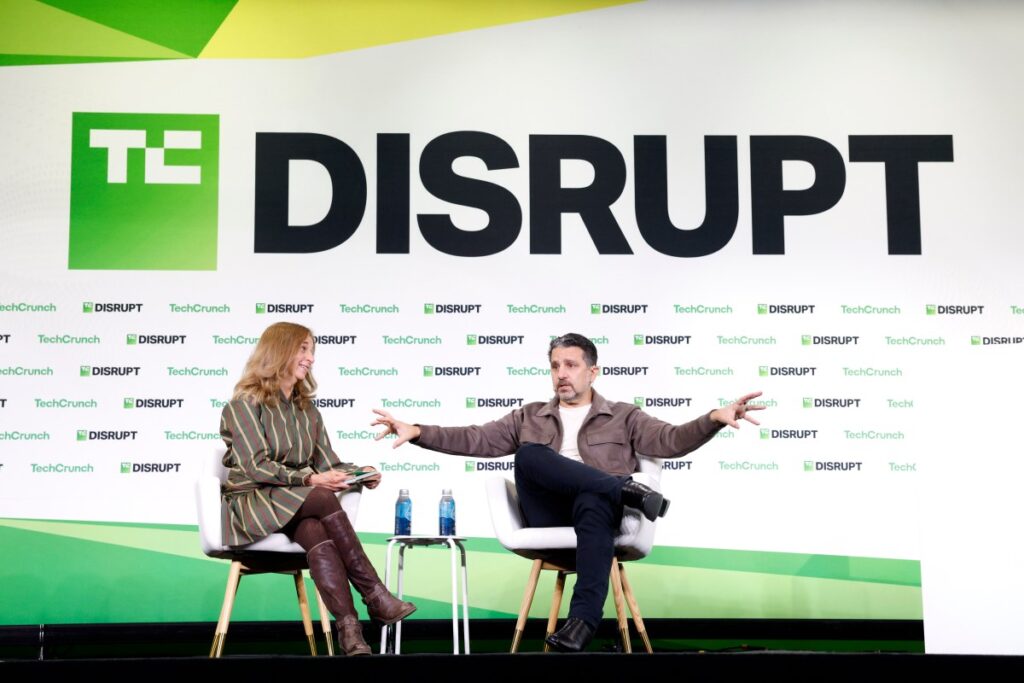
Amazon devices chief Panos Panay on the importance of failure and bouncing back from it
Amazon executive Panos Panay has a message for startup founders: Failure is an inevitable, required part of building a successful product.
Panay, Amazon SVP of Devices, Alexa, and Leo, shared that advice onstage at TechCrunch Disrupt in San Francisco, drawing on his own experience at Microsoft, where he spent more than 19 years and weathered one particularly expensive failure.
“You have to be willing to fail, and actually, not just willing, you actually have to go fail,” Panay said. “If you haven’t failed, you probably haven’t pushed the boundary. It’s literally about harvesting the lessons learned when you fail. You have to be willing to face it, and as you face it, learn from it.”
Panay said it’s possible to recover from all sorts of failures, even catastrophic ones, noting that he experienced one himself at Microsoft. He described the launch of the Surface RT, Microsoft’s first tablet computer, as a significant failure during his tenure at the company, one that ultimately led to a nearly $1 billion write-down.
“I remember being on the front cover of a newspaper, and it just said failure,” Panay said. “But, here’s the thing, it was easy to admit failure. The trick was, and always is, did you harvest the learnings and understand what happened? All right. What did you learn? Because the failure wasn’t that moment. It was decisions that led up to it two years before that, whether the software wasn’t complete or the inventory was wrong or how we balanced into retail. There were all these steps along the way.”

He said founders need to be willing to understand what went wrong, and avoid making excuses, and ultimately accept the failure.
“Here’s the other side of it,” he said. “You want to succeed, yeah? You take that failure, but you don’t let go of your vision. That’s it. Surface has done pretty well. You don’t let go of your vision. You don’t break it.”
Panay emphasized the importance of staying committed to a vision, learning from experience, and moving quickly. He believes that by embracing failure and learning from setbacks, founders can adapt and make progress faster, even as they encounter new obstacles.
“It goes back to the same fundamental, like, have you learned?” he said. “Were you learning along the way? Because if you were learning, then you just change your vector. Usually, it’s not 180 degrees. Usually, it’s just 30 degrees. Take your lessons learned, change a little bit, adapt your vision where it needs to be, and then go. I believe there’s people that hang on too long, but it’s because they haven’t accepted the moment of failure at all.”
When you purchase through links in our articles, we may earn a small commission. This doesn’t affect our editorial independence.