
Congress Is About to Make Its Biggest Crypto Decision Yet—and the Stakes Couldn’t Be Higher
Key Takeaways
- Patrick McHenry says the Clarity Act could become the most important U.S. technology law since the Telecommunications Act of 1996.
- The bill aims to provide consumer protections, regulatory certainty and clearer oversight of digital asset markets.
- Its progress through Congress is the next major catalyst for the U.S. crypto industry.
Clarity Act Could Become Congress’ Biggest Crypto Bill
Congress is considering legislation that could reshape how digital assets are regulated in the United States. The Clarity Act would establish a comprehensive federal market structure for crypto, giving companies clearer operating rules while creating protections for consumers and investors.
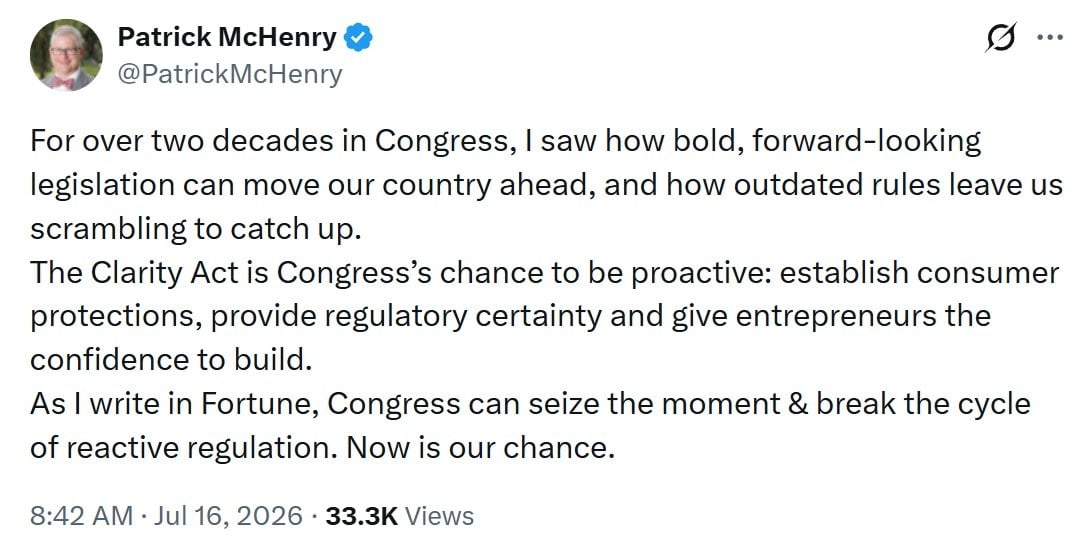
Among the bill’s most prominent supporters is Patrick McHenry, the former North Carolina congressman who chaired the House Financial Services Committee before retiring in January 2025. Now a senior adviser at Lazard, McHenry has remained active in financial policy discussions and is urging lawmakers to seize what he sees as a pivotal moment for U.S. crypto regulation.
In a July 16 post on X, he argued that Congress has an opportunity to move beyond “reactive regulation” by passing legislation that provides regulatory certainty, consumer protections, and greater confidence for entrepreneurs building in the digital asset sector.
McHenry Casts Clarity Act as a Generational Technology Law
Expanding on those remarks in a Fortune op-ed, McHenry described the Clarity Act as the most significant forward-looking technology legislation since the Telecommunications Act of 1996. He said the proposal would allow Congress to prepare for technological change instead of waiting for another crisis to force a response.
The former committee chairman contrasted the bill with financial reforms adopted after the 2008 financial crisis. In his view, the Clarity Act represents a rare opportunity to create comprehensive financial policy before a major disruption occurs.
That distinction is central to his argument. Rather than adapting rules written for older markets, Congress could create a dedicated structure for digital assets while the sector is still developing.
Supporters Link Clear Rules to Consumer Protection
Consumer protection is a central part of the case for the legislation. McHenry said the Clarity Act would establish safeguards for consumers and investors while giving law enforcement agencies better tools to identify criminals and other bad actors.
Collin McCune, head of government affairs at venture capital firm Andreessen Horowitz, reinforced that argument in response to McHenry’s post. He framed Congress’ decision as a choice between stronger federal oversight and leaving consumers vulnerable to another collapse like FTX.
Supporters, therefore, present the bill as a framework for both market development and accountability. Clear federal standards would define how legitimate businesses operate while strengthening oversight across the digital asset sector.
US Crypto Leadership May Depend on Congress’ Decision
The legislation also carries implications for U.S. competitiveness. McHenry argued that global capital and innovation will move toward markets with clear rules, defined property rights, and dependable regulatory systems.
He pointed to bipartisan support for the GENIUS Act and other crypto market structure proposals as evidence that lawmakers increasingly recognize the need for dedicated digital asset legislation. The Clarity Act would extend that effort by addressing the broader structure of U.S. crypto markets.
Congressional progress on the bill is now the main catalyst. Its passage would establish a wider federal framework for the industry and influence whether the United States remains a leading destination for digital asset companies, investment and technological development.