
EU’s New Sanctions on Russia Mark ‘a New Era’ of Crypto Enforcement
Key Takeaways:
- The EU launched its 20th sanctions package, strictly targeting the entire Russian cryptocurrency industry.
- Chainalysis sees a new enforcement era, banning EU users from Russian crypto after A7A5 moved $93.3B.
- Global crypto compliance faces a shrinking environment as the EU’s 20th package targets VASPs like Meer.
Chainalysis Heralds New Era Of Crypto Enforcement With EU’s 20th Sanctions Package Against Russia
The European Union (EU) has recently issued the 20th package of sanctions against Russia. In addition to the usual designations, the bloc has introduced sweeping measures to try to stop inflows into the nation via the crypto sector.
The new sanctions include what Chainalysis claims would be one of the bloc’s most comprehensive crypto sanctions to date, targeting the entire Russian cryptocurrency industry as threat actors instead of only designating individuals.
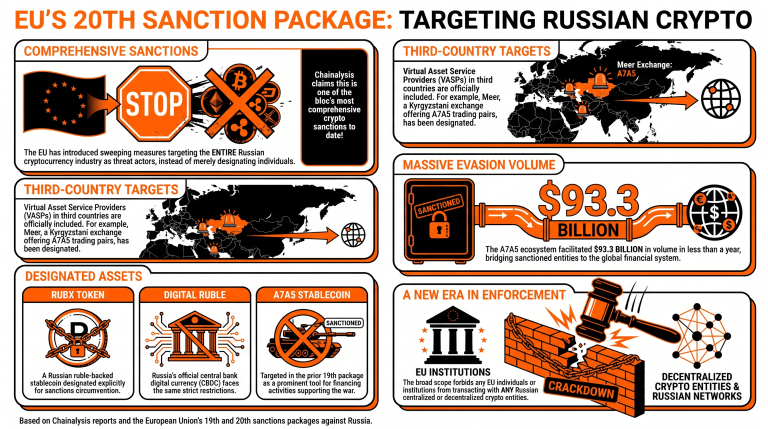
Virtual asset service providers (VASPs) located in third countries are already included in the package, as Meer, a Kyrgyzstani exchange offering A7A5 trading pairs. The A7A5 ecosystem facilitated $93.3 billion in volume in less than a year, bridging sanctioned entities to the global financial system.
This means there is a high risk of designating other exchanges, with high risks present for organizations based in Central Asia, the Caucasus, and the UAE.
The RUBx token, a Russian ruble-backed stablecoin, and the digital ruble, Russia’s own central bank digital currency ( CBDC), are also designated in the package for the explicit purpose of sanctions circumvention.
For Chainalysis, this package is more than a warning shot and represents the arrival of a new era in crypto enforcement. This view is supported by the broad scope of the designations, which forbid any EU individuals or institutions from transacting with any Russian centralized or decentralized crypto entities.
“The message to the global crypto compliance community is clear: the permissive operating environment for Russia-linked crypto activity is shrinking, and the enforcement infrastructure to back that up is firmly in place,” Chainalysis concluded.
Before, in its 19th sanctions package, the EU had targeted A7A5, another Russian ruble‑pegged stablecoin, claiming that it had become a “prominent tool for financing activities supporting the war of aggression.”