

Peter Schiff warns Strategy could sell Bitcoin as MSTR stock sinks
Strategy’s common stock has fallen below $100, prompting renewed criticism from Bitcoin skeptic Peter Schiff, who argues that further declines could leave the company facing difficult decisions over its Bitcoin treasury strategy.
Summary
- Peter Schiff warned that a deeper MSTR stock decline could eventually force Strategy to sell Bitcoin.
- Strategy raised $335.5 million through stock sales, allocating $35 million to buy 520 BTC.
- CryptoQuant urged Strategy to pause Bitcoin purchases and rebuild cash reserves as dividend obligations rise.
According to comments posted by Schiff on X, sustained pressure from short sellers could push Strategy into a situation where repurchasing its own shares becomes more attractive than continuing to accumulate Bitcoin.
He suggested that selling some Bitcoin to fund stock buybacks could help narrow the discount between the company’s market value and its underlying assets, though he questioned whether such a move would restore investor confidence.
Schiff also claimed that any forced sale of Bitcoin by Strategy could have consequences for the broader market, arguing that liquidating part of its holdings would likely weigh on Bitcoin prices.
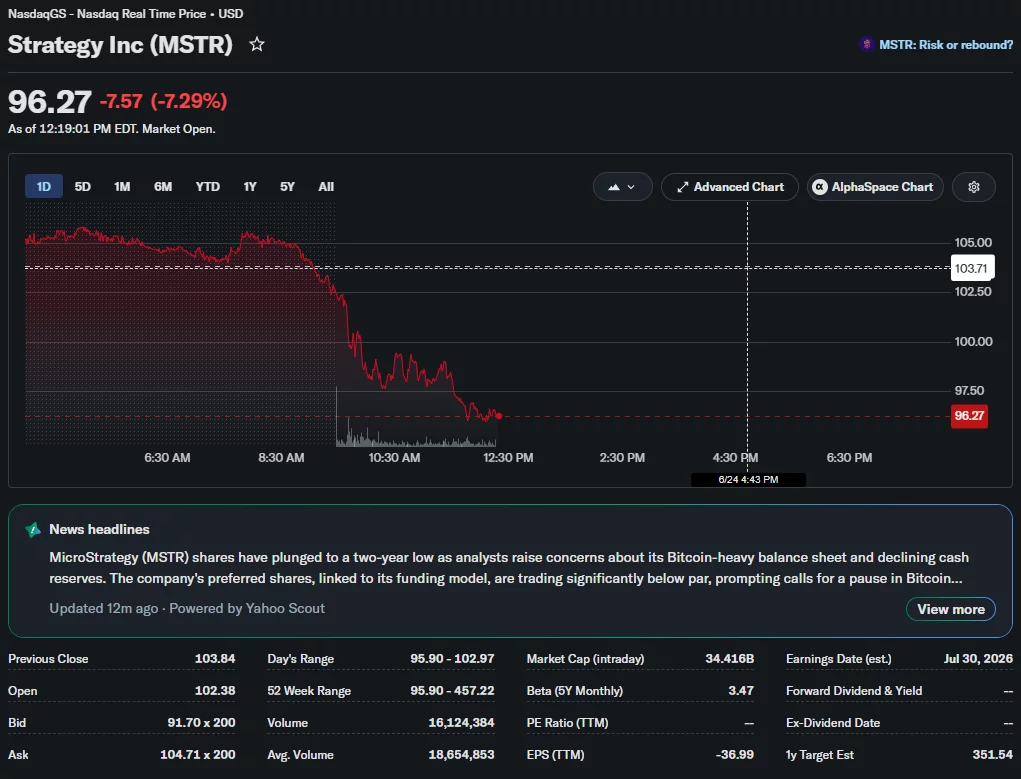
The warning comes as Strategy shares continue to slide. MSTR traded at $96.27 on June 24, down 7.2% during the session and near its lowest level in two years. Regulatory filings show the stock has lost nearly 20% over the past five trading days and more than 38% over the last six months.
Cash reserves face growing scrutiny
Recent capital allocation decisions have added to the debate surrounding Strategy’s balance sheet. Company disclosures show that Strategy sold approximately 2.71 million MSTR shares last week, generating about $335.5 million in proceeds.
Executive Chairman Michael Saylor later disclosed that the company used roughly $35 million of that capital to purchase 520 Bitcoin. At the same time, Strategy increased its U.S. dollar reserves by about $300 million, bringing its cash balance to approximately $1.4 billion.
Saylor stated that the larger cash position is intended to support the credit quality of Strategy’s Digital Credit securities, a group of products that has become increasingly important to the company’s financing structure.
Separate concerns have emerged from on-chain analytics firm CryptoQuant, which recently urged Strategy to slow its Bitcoin purchases and focus on rebuilding liquidity. According to CryptoQuant, annualized dividend obligations tied to the company’s preferred stock products have climbed to roughly $1.2 billion.
Preferred stock obligations draw attention
CryptoQuant’s concerns center on STRC, Strategy’s perpetual preferred stock product. The firm reported that the company’s cash reserves have fallen 38% in 2026, while dividend coverage has dropped from more than seven years to about 14 months.
According to CryptoQuant, restoring coverage to 24 months would require roughly $2.8 billion in cash, nearly double Strategy’s current reserves.
CryptoQuant CEO Ki Young Ju also argued that Strategy’s Bitcoin purchases are no longer a major price catalyst. He said buying during periods of strong selling pressure may help defend Bitcoin’s range but is unlikely to spark a new rally.
Given those conditions, Ju recommended pausing additional Bitcoin purchases, rebuilding cash reserves, and adopting a more structured buying strategy.
In a follow-up X post on June 24, Schiff expanded his criticism to Strategy’s STRC preferred stock. He argued that the security had been marketed to risk-averse retirees as a lower-volatility way to gain exposure to the company’s Bitcoin strategy, despite falling more than 5% on the day and over 17% below levels where many investors reportedly purchased shares the previous month.
Schiff further claimed that the decline had erased nearly two years of dividend income and accused Saylor of making “material misrepresentations” when describing the preferred stock.