
The altcoin depression: Ex-BTC/ETH market down 23%

Strip Bitcoin and Ethereum out of the crypto market and what remains has shed almost a quarter of its value in the first half of 2026, falling to $666 billion while liquidity retreats into a handful of survivors. This is not a crash; crashes end. It is something slower and stranger: a depression in the long tail of crypto, with its own causes, its own refugees, and its own short list of assets that refuse to participate.
Summary
- The ex-Bitcoin and ex-Ethereum crypto market lost nearly 23% in the first half of 2026.
- Liquidity is retreating from the long tail into Bitcoin, stablecoins, and a few assets with stronger revenue mechanisms.
- The current altcoin downturn looks more like a slow structural depression than a fast liquidation crash.
- Token supply glut, ETF-driven institutional access, and the rise of perpetual trading have weakened broad altcoin demand.
- The main survivors are tokens with real fee flows, buybacks, or utility that does not depend purely on retail speculation.
The number that best describes crypto in mid-2026 is not Bitcoin’s price. It is this one: the total market capitalization of every cryptocurrency except Bitcoin and Ethereum fell 22.84% in the first half of the year, down to $666.58 billion as of July 2. Bitcoin, for all its drama, a 21-month low of $58,188 in late June, a bounce back above $62,000, trades within a wide band it has occupied before. The long tail is somewhere it has not been in years: bleeding steadily, month after month, with no single catastrophic day to blame and no capitulation candle to mark a bottom.
The individual charts are grim in a way indexes flatten. Ethereum, the second pillar, just closed three consecutive red quarters for the first time in its history, down 28% in the second quarter alone to trade near $1,740, roughly 65% below its August 2025 peak. Solana sits in the high $70s to low $80s. Worldcoin fell 80% over seven months; Pi Network printed all-time lows 96% below its peak; MicroStrategy’s stock, the market’s favorite leveraged proxy, was the worst performer in the entire Nasdaq-100 last year and trades 85% below its 2024 high. The Fear and Greed Index touched 12 this month, readings last seen at the bottom of the previous cycle, and sentiment surveys read like obituaries.
And yet, scattered across the wreckage, a short list of assets is behaving as if none of this is happening: a perp exchange token near all-time highs, a lending token up 40% in a month on a buyback, a supposedly dead layer-1 up 31% in a week. The pattern of who is exempt is as informative as the destruction itself. This piece maps the altcoin depression properly: how the damage is distributed, the three structural forces that caused it and distinguish it from an ordinary bear market, the anatomy of the exceptions, the honest bull and bear cases for what comes next, and the historical precedents that both camps are quoting at each other.
The shape of the damage
Start with what the aggregate number hides. A 23% half-year decline in the ex-BTC-ETH market sounds survivable until it is decomposed, because the aggregate is propped up by its largest and most defensible members, stablecoins, exchange tokens, the top handful of layer-1s, which means the decline in the actual long tail is far deeper. Move down the capitalization table and the drawdowns compound: mid-caps routinely 60-80% below their 2025 highs, the memecoin complex down by more, and the sub-$100 million tier functionally illiquid, with tokens drifting on a few thousand dollars of daily volume. The market has not fallen uniformly; it has hollowed out from the bottom.
The flows data explains the mechanism. Capital is not so much leaving crypto as retreating inward along the risk curve: into Bitcoin, into stablecoins, whose aggregate supply has kept growing through the drawdown, and into a few narrative fortresses. Bitcoin dominance has ground higher all year, the ETF complex institutionalized a version of crypto exposure that simply does not include the long tail, and the marginal retail buyer, the historical engine of altcoin seasons, is conspicuously absent, with new-wallet and app-download metrics at multi-year lows. When markets are healthy, liquidity spreads outward toward risk; when they are frightened, it retreats toward quality and exits through the same narrow doors it entered. The first half of 2026 has been eighteen consecutive weeks of the second pattern.
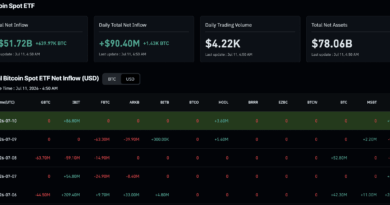
Two aggravating events bracketed the half. The macro turn, a hot inflation print, Bank of America forecasting three rate hikes into 2026’s back half, and gold and AI equities absorbing the speculative appetite crypto once monopolized, reset the discount rate on every long-duration asset, and nothing has longer duration than a token whose cash flows are hypothetical. And the ETF reversal removed the market’s newest demand engine precisely when it was needed: after absorbing supply for eighteen months, spot Bitcoin funds bled $4.51 billion in June alone, their worst month on record, roughly $7 billion across May and June, converting the structure that had validated the asset class into a source of daily sell pressure and headline gloom that the long tail, which never even had ETFs, absorbed by proxy.
A tour of the casualty list
Abstractions need faces, and the depression’s casualty list is best understood as concentric rings around the majors.
The first ring is the large-caps that were supposed to be safe. Ethereum’s three consecutive red quarters, the first such streak in its existence, ending with a 28% second-quarter loss, did more damage to the market’s psyche than any memecoin implosion, because ETH was the institutional asset, the one with ETFs, staking yield, and a corporate buyer base, and it fell 65% from its peak anyway. Solana, the cycle’s performance champion, trades in the high $70s, its ecosystem activity, notably resilient, decoupled from its token price in exactly the way bulls once promised could not happen. XRP holds near $1.10 with the most institutionally credentialed story in the sector and a chart that ignores it.
The second ring is the narrative tokens, and here the numbers turn brutal: Worldcoin down 80% across seven months, Pi Network at all-time lows 96% below peak, the two of them jointly holding the most commercially promising identity thesis in crypto and jointly demonstrating that theses without token mechanisms no longer receive the benefit of the doubt. The AI-agent complex, the restaking complex, the modular complex, each of 2024-25’s manufactured metas has round-tripped, their tokens down 70-90% while, in several cases, their underlying usage grew, the market’s new discipline applied without sentiment.
The third ring is the equity shadow market, where the depression is arguably deepest: MicroStrategy 85% off its high and the treasury-company complex trading at or below the value of its own coins, the crypto IPO class down 42-89% with its pipeline frozen, and the mining sector repricing around AI-datacenter pivots because coin economics alone no longer support the multiples. When the leveraged wrappers, corporate, listed, and structured, all compress toward or below net asset value simultaneously, the market is making a single statement across every instrument: it will pay for crypto’s contents, and it will no longer pay a premium for containers.
And beneath all three rings lies the true dead zone, the thousands of sub-$100 million tokens where the depression is not a price level but a liquidity condition: order books measured in thousands of dollars, market-making contracts lapsing, volumes that round to zero. No index captures this stratum because indexes weight by capitalization, but it is where most tokens actually live, and its condition is the honest answer to what the altcoin market is in mid-2026: not cheap, not expensive, but in the majority of cases simply unpriced, waiting for either a buyer or a delisting.
Why this is a depression and not a crash
Crypto has crashed many times, and this is not what those looked like. Crashes are violent, leveraged, and fast: a cascade, a weekend of liquidations, a V-shaped aftermath. The 2026 altcoin market is experiencing something with different physics, a slow structural repricing driven by three forces that do not resolve with a bounce.
The first is terminal supply glut. The token-creation machinery built in 2024-25, led by Pump.fun’s million-plus launches but including every launchpad, points program, and airdrop meta, produced assets far faster than the market produced holders, and the professionalized unlock calendar keeps delivering supply into weakness: more than $776 million of scheduled unlocks this week alone, with the sector’s largest single cliff landing Saturday. Every project financed in the 2021 and 2024 vintages is now vesting into a market with no marginal buyer, which functions as a standing tax on the entire asset class. Previous altcoin winters ended when new demand met fixed supply; this one must end against supply that grows on a schedule.
The second is the rerouting of institutional access. The ETF era was supposed to legitimize crypto broadly; what it actually did was create a compliance-approved lane for exactly two assets, soon a handful more, and drain the legitimacy premium from everything outside the lane. An allocator who wants crypto exposure in 2026 buys the funds; the reflexive spillover into altcoins that characterized retail-driven cycles has no institutional equivalent, because no pension committee rotates winnings into mid-cap layer-1s. The long tail has been structurally decoupled from the asset class’s own adoption story, and the decoupling is visible in every chart pair: Bitcoin flat on the year at this writing, the ex-majors index down by a quarter.
The third is the migration of the speculative economy itself. The activity that once expressed itself as altcoin buying now expresses itself as perpetual-futures trading, where the same directional appetite generates volume and fees without anyone holding a token overnight, the instrument having become the market’s true center of gravity. Decentralized perp venues’ share of open interest has nearly quadrupled year over year to 13.5%, volumes concentrate in venues rather than assets, and the professionalization is self-reinforcing: why own a token’s drawdown risk when its volatility can be rented by the hour? The long tail’s former buyers did not leave the casino; they moved from owning the chips to trading the table.
The stablecoin paradox and the macro vise
Two forces frame the depression from outside, and both are widely misread.The first is the stablecoin paradox: through six months of risk-asset destruction, aggregate stablecoin supply grew, and it now stands as one of the largest pools of capital inside the crypto perimeter. Bulls read this as dry powder, an army of dollars parked on-chain awaiting redeployment, and the reading has a real mechanism behind it, since capital that intended to exit crypto entirely would have redeemed to banks instead of rotating to Tether and Circle. Bears read the same data as infrastructure, not intent: stablecoins grew because they became payment rails, collateral, and settlement instruments for uses that have nothing to do with buying altcoins, the yield-bearing plumbing of a parallel dollar system, and mistaking plumbing for a bid is how every failed bottom call of the past year was constructed. Both readings are partially right, which is the paradox: the money is there, and nothing about its presence obligates it to arrive.
The second frame is the macro vise, and it deserves respect as a cause rather than an excuse. The asset class that grew up entirely inside a low-rate world is now pricing Bank of America’s projection of three hikes into late 2026, December hike odds above a third on CME’s tracker, and a Federal Reserve meeting on July 29 that markets treat as a live risk event. Long-duration speculative assets reprice first and hardest under tightening, and the long tail of crypto is the longest-duration asset class ever invented. Layer onto that the attention competition, AI equities absorbing the thematic capital and the narrative oxygen that altcoins monopolized in prior cycles, and gold absorbing the debasement trade, and the depression acquires its external half: even a structurally healthy altcoin market would be fighting the tape, and this one is not structurally healthy. The Fear and Greed Index at 12 measures the collision of the internal and external stories, and its historical record, extreme readings preceding reversals, is the single most cited statistic in every bull’s arsenal, cited, as bears note, at 20 as well, and at 15, all the way down.
The depression also has a geography worth noting: it is unevenly distributed across chains as well as capitalizations. Solana’s application economy has held activity remarkably well even as SOL fell, Ethereum’s layer-2 complex has kept throughput growing while its tokens bled, and several ecosystems have effectively bifurcated into functioning networks with failing tokens, the clearest evidence yet that usage and token value have decoupled at the base layer too. The decoupling reads bearish today and cuts ambiguous tomorrow: networks that stay busy through a depression retain the raw material, users, developers, fee flows, from which mechanisms can later be built, while quiet chains with quiet tokens have neither.
The exceptions, and what they share
Against that backdrop, the survivors form a pattern too consistent to be luck, and the pattern is cash flow with a mechanism attaching it to the token.
Hyperliquid is the archetype: a perp exchange near all-time highs in a bleeding market, because 97% of its enormous fee revenue mechanically buys its token every block, a structural bid this publication dissected in May. Aave rallied roughly 40% in a month after switching on fee-funded buybacks. The pattern extends to venues, launchpads, and protocols whose revenue is real and whose tokenomics route it to holders, and it conspicuously excludes projects with identical revenue and no routing: the market has stopped paying for adoption stories and started paying, narrowly and skeptically, for distributions. Call it crypto’s dividend repricing; in a depression, only the assets that pay you to hold them get held.
The second class of exceptions is idiosyncratic reversal from the dead zone, Cardano’s 31% weekly bounce from multi-year lows being the current specimen, and these are better read as the volatility of abandonment than as recoveries: when a major asset’s holder base has been reduced to conviction and neglect, small demand produces large moves in both directions. The third class is the RWA-and-infrastructure complex, tokenized Treasuries growing straight through the drawdown and the perp venues annexing equities and commodities, which is not altcoin strength at all but the market routing around altcoins entirely, building things institutions want on rails the long tail happens to share, proof-of-human networks being the cautionary counter-example of vast userbases that never found the mechanism.
The exceptions also share a negative property worth stating: none of them is a bet on the altcoin market recovering. Hyperliquid’s buyback runs on trading volume that exists in every market weather; Aave’s fee stream runs on lending demand that persists through drawdowns; the RWA complex runs on institutional needs that have nothing to do with retail speculation. The survivors are, almost by definition, the assets that found a customer other than the crypto cycle itself, which inverts the sector’s old logic completely. In previous cycles, the long tail was leveraged exposure to crypto’s growth, the beta on the beta; in this one, the only long-tail assets working are the ones that de-correlated from that growth entirely. The depression, seen through the survivors, is not punishing altcoins for being risky. It is punishing them for being redundant, for offering exposure to an asset class that Bitcoin, Ethereum, and the ETFs now deliver with less risk, and rewarding, narrowly, whatever offers something else. That is a harsher filter than any bear market, because bear markets end, and redundancy does not.
The bear case, the bull case, and the precedents
The bear case says this is not a cycle but a verdict. The long tail was an artifact of zero rates, retail mania, and the absence of regulated alternatives; all three conditions are gone, the supply overhang is permanent, and the correct comparison is not crypto 2018 but small-cap altcoins after 2018, thousands of which never recovered because nothing required them to. On this reading, the 23% half is not a drawdown to be recovered but a repricing toward a world where perhaps a few dozen tokens have durable claims on value and the rest converge, slowly, on their terminal worth. The absence of capitulation is itself the tell: markets that cannot crash cannot bottom.
The bull case answers with the same history read differently. Every previous altcoin winter, 2015, 2018-19, 2022, featured identical obituaries, identical dominance grind, identical proclamations that this time the long tail was structurally dead, and each resolved when a demand catalyst met a market positioned exactly like this one: Fear and Greed at cycle-bottom readings, funding negative, sentiment surveys unanimous, and the sellable supply, per the flows data, increasingly transferred from weak hands to strong. The catalysts are even legible in advance: the CLARITY Act’s resolution would extend regulated access beyond the ETF duopoly, three specific fights currently deciding it; a Fed pivot would reprice duration assets in unison; and the halving-cycle clock that bulls treat as scripture points to exactly this phase, maximum despair, preceding rotation. The 23% number, on this reading, is what the bottom of an accumulation phase looks like from inside it.
The honest synthesis is narrower than either slogan. Both camps are describing real mechanisms; the question is which applies to which stratum. The structural forces, supply glut, institutional rerouting, speculation’s migration to perps, are genuine and will not reverse with sentiment, which argues the bear case is right about the median token. The positioning extremes, the survivor pattern, and the catalyst calendar are equally genuine, which argues the bull case is right about the market’s investable core. A depression, unlike a crash, does not end for everyone at once: it ends first for the assets with cash flow and mechanisms, later for the assets with users and stories, and never for the rest. The 23% figure will eventually be revised by a recovery; how much of the long tail participates in that revision is the actual bet, and the first half of 2026 has been the market showing, asset by asset, exactly how it intends to grade it.
A word, finally, on how to actually navigate a depression, because the historical playbook differs from the crash playbook most participants trained on. Crashes reward buying panic and selling relief; depressions reward selection and patience, and punish both panic-buying and generalized bottom-fishing, since the defining feature of the regime is that most of what looks cheap is cheap for a reason and will get cheaper or simply stay dead. The discipline the survivors’ pattern suggests is uncomfortable but legible: hold the market’s investable core to whatever extent one holds the asset class at all; demand a mechanism, revenue routed to holders, structural buybacks, genuine fee claims, before treating any long-tail position as investment rather than trade; treat narrative without mechanism as rental property, entered and exited with the attention cycle; and respect the unlock calendar as a standing map of scheduled supply, because in a market without a marginal buyer, the vesting schedule is the price forecast. None of this is exciting, which is rather the point: depressions transfer wealth from participants who need excitement to participants who can do without it.
The last observation belongs to the long view. Crypto has now run this experiment enough times for the shape to be familiar: a technology wave mints an asset class, the asset class overproduces claims on the future, the claims deflate for years while the technology quietly compounds, and the next wave is built by whoever kept working through the deflation. The 2026 altcoin depression is that middle phase executing on schedule, and its most reliable historical property is also its least appreciated: the assets that lead the next cycle are rarely the ones that led the last, and are frequently being built, unlisted and unpriced, during exactly this kind of silence. The $666 billion question is not when the long tail recovers; it is which fraction of the current long tail has anything to do with what recovers, and the honest answer, on every precedent available, is: less than its holders hope, and more than its obituaries allow.
For the record, the numbers to watch from here are few and public: the ex-majors market capitalization itself, whose trend break above the H1 downchannel would be the first structural all-clear; Bitcoin dominance, whose rollover has preceded every genuine altcoin rotation on record; the weekly unlock calendar against long-tail volumes, the supply-demand scissors in one glance; and the count of tokens with live buyback or fee-distribution mechanisms, the survivor class’s census, which grows every month and quietly defines what the next cycle’s investable universe will look like. Depressions end without announcements. They end in data series, and these four will carry the announcement when it comes.
However it resolves, the first half of 2026 has already earned its place in the asset class’s institutional memory, the six months in which the market stopped grading crypto on its future and started grading it, token by token, on its books.
Disclaimer: This article is for informational purposes only and does not constitute investment advice. Digital asset markets are volatile and you can lose your entire investment. Figures are current as of July 9, 2026, and may change. Always do your own research.