

Why is Bitcoin price down today (November 3)?
Bitcoin (BTC) price has fallen below $77,000 on November 3, as renewed institutional withdrawals, leveraged liquidations and weakness in global technology stocks have pressured cryptocurrency markets.
Summary
- Bitcoin price has fallen 2.19% to $76,455.56, extending its seven-day decline to 3.59%.
- U.S. spot Bitcoin ETFs recorded $398.6 million in outflows on November 2, following $643.3 million on October 30.
- Bitcoin liquidations reached $88.83 million over 24 hours as leveraged traders faced further selling pressure.
- Weakness in technology stocks and uncertainty surrounding the November 3 U.S. midterm elections weighed on market sentiment.
- Bitcoin price prediction levels place immediate support near 76,400–76,500, with resistance around $78,000 and $79,500.
According to crypto.news market data, Bitcoin traded at around $76,460, down 2.19% over the previous 24 hours. Trading volume reached $26.62 billion, while the cryptocurrency’s market capitalization stood at $1.54 trillion.
Tuesday’s decline erased Monday’s brief recovery, leaving Bitcoin below the $77,600 area it tested late Sunday. The latest decline coincided with falling Asian equities and investor caution ahead of the U.S. midterm elections.
Bitcoin price falls as ETF outflows continue
Selling pressure in U.S. spot Bitcoin exchange-traded funds has continued following the October 29 Binance security breach.
Data reported by SoSoValue showed that Bitcoin ETFs recorded $398.6 million in net outflows on November 2. BlackRock’s IBIT accounted for $405.3 million in withdrawals, exceeding the combined net outflow across the funds.
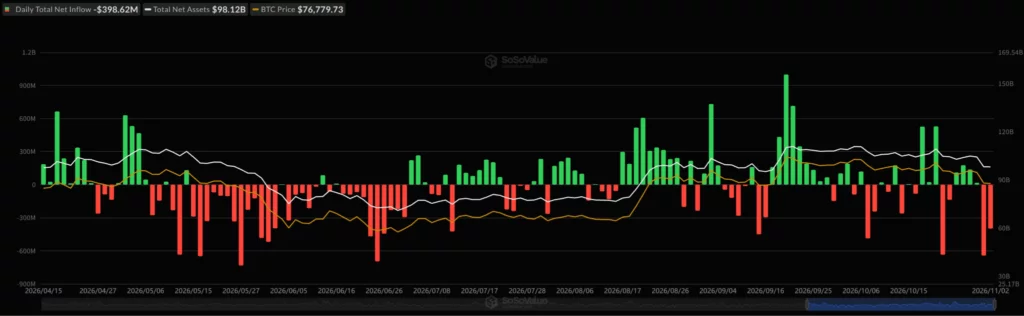
Other products recorded smaller inflows that partly offset BlackRock’s redemptions. Fidelity’s FBTC attracted $6.68 million during the session.
Friday’s withdrawals were even larger, with spot Bitcoin ETFs losing $643.3 million on October 30, their biggest single-day outflow since June.
Ethereum ETFs recorded another $140 million in net outflows on November 2, extending weakness across institutional cryptocurrency investment products.
The selling followed the record Binance security breach, which affected more than $6.3 billion in cryptocurrency assets.
Blockchain investigators have continued tracking the stolen funds, although the exchange said it had replaced most affected customer assets.
As crypto.news reported on Monday, Bitcoin briefly recovered toward $78,000 following the initial sell-off.
However, the recovery failed to regain the $80,000 level, leaving buyers struggling to reverse the recent losses.
Technology stocks and liquidations weigh on BTC
Bitcoin’s decline occurred alongside another downturn in global technology shares, particularly companies connected to artificial intelligence and semiconductor manufacturing.
Asian equity markets fell Tuesday following losses among major U.S. technology stocks. Investors were preparing for the November 3 midterm elections, with results expected after voting ended.
The broader cryptocurrency market lost 1.92% over 24 hours, while Bitcoin declined slightly faster.
Solana dropped roughly 3%, BNB slipped below $700, and Ethereum traded near $2,250. Hyperliquid’s HYPE fell around 5%.
Derivatives activity added pressure as traders holding leveraged positions faced forced closures.
According to CoinGlass, Liquidation data showed nearly $100 million in Bitcoin positions closed during the previous 24 hours, with long positions accounting for most losses.
Such liquidations occur when exchanges automatically close positions that no longer maintain enough collateral.
As Bitcoin falls, leveraged bullish traders can face additional selling when their positions are liquidated.
Bitcoin price prediction: can $76,400 support hold?
Technical indicators continue showing weakness on Bitcoin’s daily chart, with BTC forming lower highs and lower lows since early October.
The Relative Strength Index stood at 34.26, below its moving average of 41.67. The reading indicated weak buying momentum, although Bitcoin had not crossed the conventional oversold threshold of 30.
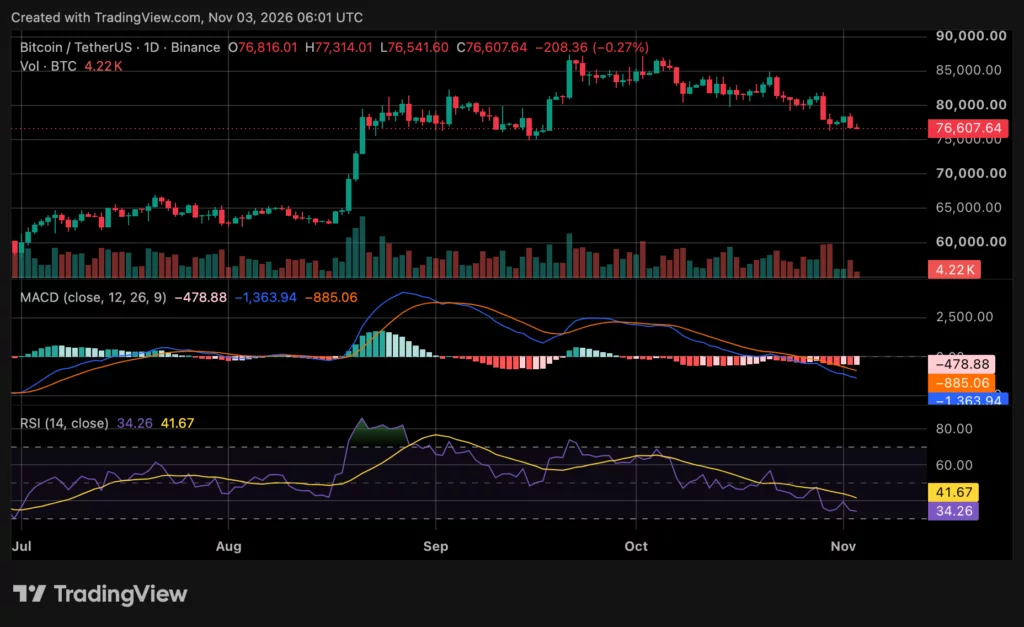
Its Moving Average Convergence Divergence indicator remained negative, with the MACD line at -1,363.94 against a signal reading of -885.06.
The histogram stood at -478.88, showing that downward momentum had continued.
Crypto analyst That Martini Guy identified $76,400 as an important level after Bitcoin failed to reclaim its previous support near $79,500.
“The level I’m paying close attention to now is $76,400,” the analyst wrote.
He warned that losing this area on a convincing four-hour close could lead to further declines.
“I wouldn’t be rushing to call a bottom just because BTC is testing support,” he added.
A recovery above $79,500 would provide an early indication of improving momentum, according to his analysis.
Bitcoin faces resistance near $78,000 and $80,000
Immediate Bitcoin support sits near $76,500, followed by $75,000 and the 50-week moving average around $75,602.
A sustained decline below those levels could bring the $74,800 area into focus, while a recovery would first encounter resistance near $78,000.
The $79,500 and $80,000 levels remain additional obstacles following Bitcoin’s failed rebound earlier this week.
Another crypto analyst, Daan Crypto Trades, pointed to Bitcoin’s annual performance, noting that it has never recorded two consecutive negative yearly candles.
“2026’s yearly open sits at $87.5K,” the analyst wrote.
With Bitcoin trading well below that level, its year-to-date performance remains negative at the current price.
The market’s next major U.S. economic release is scheduled for November 6, when the October employment report is due.
Disclosure: This article does not represent investment advice. The content and materials featured on this page are for educational purposes only.